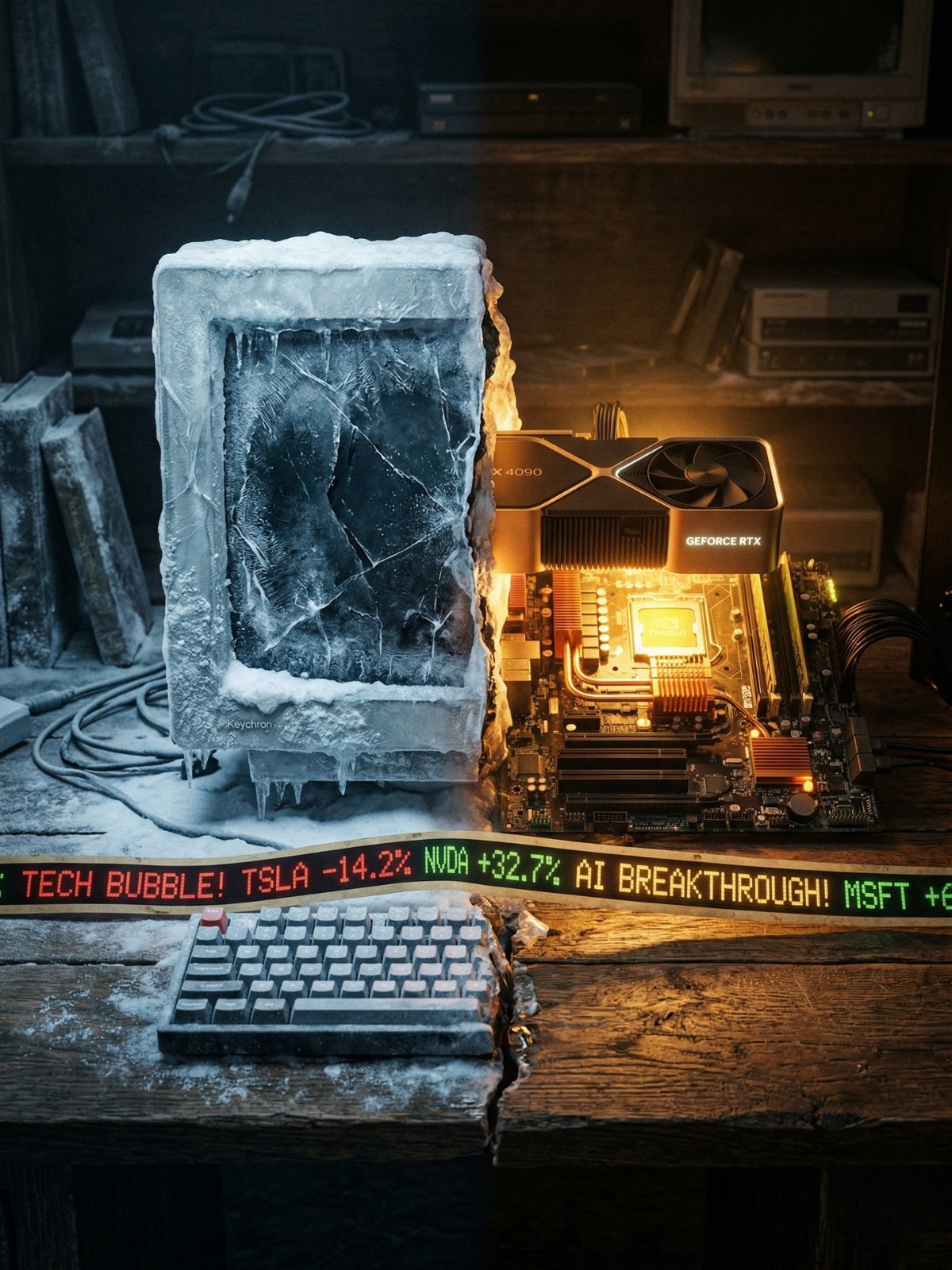
Wall Street and Silicon Valley speak different languages in 2024-2025
In November 2024, Nvidia crossed $3 trillion in market capitalization on the NASDAQ. Thirty-six months before, it was worth $500 billion. Wall Street traders are betting that demand for chips to train AI will grow exponentially for at least another decade. It's a bold bet. Possibly right. Possibly an illusion.
Meanwhile, in San Francisco, some investors ask the uncomfortable question. How long can a run like this hold up before reality steps in?
The case for a "third winter"
Listen to it, because it's valid.
First: valuations disconnected from reality. Nvidia trades at price/earnings multiples at the top of the historical range. The justification is long-term demand projections. But projections are estimates. They're fragile. If in 2027 AI training demand doesn't grow as expected, valuations drop hard.
Second: promises are deflating. Two years ago the talk was "AGI in 5 to 10 years." Today the same executives talk about "incremental improvements on specific tasks." That isn't narrative progress. It's hype compression. According to the Gartner Hype Cycle 2024, generative AI has entered the phase Gartner calls the "trough of disillusionment."
Third: venture capital is getting picky. Eighteen months ago, VC would invest in any startup that mentioned "AI" without asking for numbers. Today they want real traction, verifiable users, revenue. When that happens, many startups without numbers disappear.
Fourth: governments can hit the brakes. AI's energy consumption is huge. Training and serving large models burns as much electricity as mid-sized cities. If governments decide it's wasteful or unsustainable, they can impose restrictions. There's already movement — European regulations, chip restrictions toward China, US debates about sustainability.
Fifth: this looks like past booms. Dot-com (2000). Expert systems (1987). Real estate booms. Lots of money, too many promises, reality falls short. Then: crash. Winter.
The argument is assembled. It sounds plausible.
The case against: the structural difference
But there's a radical difference from 1987 and 2000.
In 1987, if expert systems disappeared, what did people lose? Researchers lost funding. Corporations lost invested money. But most of the world didn't depend on them existing. They were niche. Specialized. Marginal in daily life.
Today:
Gmail processes hundreds of billions of emails per day. Since 2005, spam filtering uses machine learning. Billions of people use it without thinking. Nobody calls it "AI." Spam just doesn't hit your inbox.
Google Search has used deep learning in ranking for over a decade. When you search the internet, you're using neural language models. Around 8 billion searches per day. Per Alphabet's financial filings, Google generates over $280 billion annually in advertising, largely because search works. AI is inseparable from that.
Microsoft 365 has Copilot integrated in Word, Excel, and PowerPoint. Millions of corporate workers use it. Pulling it now would break workflows people already depend on.
Automatic transcription in Zoom, Teams, and Fireflies. Millions of meetings transcribed automatically every day. You talk for 60 minutes, you have the text in 10 seconds. Didn't exist 5 years ago. Standard now.
AI-assisted medical diagnostics. Radiologists using machine learning to detect cancer. Pathologists using vision models. FDA-regulated and saving lives. Not speculation.
If all this infrastructure failed at once, the impact would be comparable to a massive power outage. Economically unsustainable. Politically unacceptable. Therefore, very hard to happen.
And — this matters — the money no longer comes only from public speculation.
Previous winters happened when funding was concentrated. DARPA in the 1970s. Speculative and limited corporate VC in the 1980s and 1990s. Today it's different. Anthropic has accumulated investment rounds exceeding $10 billion according to financial reporting, but it also generates revenue because companies like Google and Salesforce use Claude and pay for access. OpenAI bills through direct subscriptions (ChatGPT Plus) plus enterprise contracts. Google, Microsoft, Meta, and Amazon have AI embedded in products that generate real revenue (advertising, productivity, recommendations). Stanford HAI and MIT-IBM Watson Lab keep doing public research without depending on speculative VC.
Funding is diversified. If one source dries up, others keep the field running.
So what's coming?
Probably a correction, not a winter.
A correction means: many marginal AI startups close because they have no business model; VC money turns conservative and only funds companies with clear product-market fit; big-tech stocks drop 30 to 40% (a normal market correction); executives talk less about "revolutions" and more about "improvements"; valuations adjust downward.
But: the AI that already works stays. Claude, ChatGPT, and Gemini keep evolving. Companies keep using AI because it saves money. Researchers keep researching.
A correction is a market maturing. A winter is a technology failing.
One question to leave you with
Watch what you use. If in 2026 or 2027 you see startups closing but Gmail still filtering spam, Google Search still running, and millions of people still opening Claude every day, that's a correction. If you see everyone abandoning AI at once and it disappears from the products you use, that would actually be a winter. But it's very unlikely because too many people depend on it working. If you want to understand in more depth why hype-and-correction cycles are structural in this field, read #0002 on the previous winters.
The thin line between a bubble and a boom
Picture this. You invest in something because you believe it's about to explode in value. Everyone around you invests too. The price climbs. It climbs more. Money is pouring in. Nobody wants to be the one who missed the opportunity of the century. Until someone asks the uncomfortable question: wait, is this really worth what we're paying for it?
Then everyone sells at once. The price crashes. The money disappears. And the people who invested ask themselves how they let it happen.
That happened in 1987 with expert systems. Is it happening now with AI?
Signals that it might be a bubble
Nvidia is worth around $3 trillion today, per the 2024 NASDAQ closing price. Three years ago it was worth around $500 billion. That kind of growth isn't sustainable forever. At some point, the market adjusts.
Promises have toned down. In 2023 you were hearing executives talk about "artificial general intelligence coming in 5 years." In 2025, the same executives talk about "incremental improvements on specific tasks." When promises shrink, the hype is deflating.
Speculative money turned cautious. A year ago, any startup with "AI" in the pitch raised millions, no questions asked. Today investors ask for real numbers — users, revenue, verifiable growth. Easy money is walking out the door.
But there's a huge catch
Gmail, Google Search, Microsoft Copilot, ChatGPT, Claude. They're already in your hands. You already use them. They already work.
If the AI market collapsed tomorrow, what would actually happen? Your email would still filter spam. Your search would still work. Your company's data analysis would keep going. In 1987, if expert systems disappeared, what did you lose? Academic research almost nobody used in real life. Today AI is embedded in infrastructure that billions of people depend on every day.
So what's coming?
Probably a correction, not a winter. A correction is: many startups close, speculative money walks away, tech stocks drop 30 to 40%, promises get modest. A winter would be: the technology itself collapses and the products stop existing.
Watch what you use. If Claude or ChatGPT stops existing, yes, that's a winter. If they keep existing but investment drops and some startups close, that's a correction.
Takeaways:
Three points to pin down. First, there is a speculative bubble, that part is true — valuations are stretched and something will pop. Second, it isn't pure bubble — AI generates real revenue, real companies use it, and they save concrete time and money. Third, correction and winter aren't the same thing — one is a market adjusting, the other is a technology dying. The first is likely. The second is very hard to imagine.
Wall Street and Silicon Valley speak different languages in 2024-2025
In November 2024, Nvidia crossed $3 trillion in market capitalization on the NASDAQ. Thirty-six months before, it was worth $500 billion. Wall Street traders are betting that demand for chips to train AI will grow exponentially for at least another decade. It's a bold bet. Possibly right. Possibly an illusion.
Meanwhile, in San Francisco, some investors ask the uncomfortable question. How long can a run like this hold up before reality steps in?
The case for a "third winter"
Listen to it, because it's valid.
First: valuations disconnected from reality. Nvidia trades at price/earnings multiples at the top of the historical range. The justification is long-term demand projections. But projections are estimates. They're fragile. If in 2027 AI training demand doesn't grow as expected, valuations drop hard.
Second: promises are deflating. Two years ago the talk was "AGI in 5 to 10 years." Today the same executives talk about "incremental improvements on specific tasks." That isn't narrative progress. It's hype compression. According to the Gartner Hype Cycle 2024, generative AI has entered the phase Gartner calls the "trough of disillusionment."
Third: venture capital is getting picky. Eighteen months ago, VC would invest in any startup that mentioned "AI" without asking for numbers. Today they want real traction, verifiable users, revenue. When that happens, many startups without numbers disappear.
Fourth: governments can hit the brakes. AI's energy consumption is huge. Training and serving large models burns as much electricity as mid-sized cities. If governments decide it's wasteful or unsustainable, they can impose restrictions. There's already movement — European regulations, chip restrictions toward China, US debates about sustainability.
Fifth: this looks like past booms. Dot-com (2000). Expert systems (1987). Real estate booms. Lots of money, too many promises, reality falls short. Then: crash. Winter.
The argument is assembled. It sounds plausible.
The case against: the structural difference
But there's a radical difference from 1987 and 2000.
In 1987, if expert systems disappeared, what did people lose? Researchers lost funding. Corporations lost invested money. But most of the world didn't depend on them existing. They were niche. Specialized. Marginal in daily life.
Today:
Gmail processes hundreds of billions of emails per day. Since 2005, spam filtering uses machine learning. Billions of people use it without thinking. Nobody calls it "AI." Spam just doesn't hit your inbox.
Google Search has used deep learning in ranking for over a decade. When you search the internet, you're using neural language models. Around 8 billion searches per day. Per Alphabet's financial filings, Google generates over $280 billion annually in advertising, largely because search works. AI is inseparable from that.
Microsoft 365 has Copilot integrated in Word, Excel, and PowerPoint. Millions of corporate workers use it. Pulling it now would break workflows people already depend on.
Automatic transcription in Zoom, Teams, and Fireflies. Millions of meetings transcribed automatically every day. You talk for 60 minutes, you have the text in 10 seconds. Didn't exist 5 years ago. Standard now.
AI-assisted medical diagnostics. Radiologists using machine learning to detect cancer. Pathologists using vision models. FDA-regulated and saving lives. Not speculation.
If all this infrastructure failed at once, the impact would be comparable to a massive power outage. Economically unsustainable. Politically unacceptable. Therefore, very hard to happen.
And — this matters — the money no longer comes only from public speculation.
Previous winters happened when funding was concentrated. DARPA in the 1970s. Speculative and limited corporate VC in the 1980s and 1990s. Today it's different. Anthropic has accumulated investment rounds exceeding $10 billion according to financial reporting, but it also generates revenue because companies like Google and Salesforce use Claude and pay for access. OpenAI bills through direct subscriptions (ChatGPT Plus) plus enterprise contracts. Google, Microsoft, Meta, and Amazon have AI embedded in products that generate real revenue (advertising, productivity, recommendations). Stanford HAI and MIT-IBM Watson Lab keep doing public research without depending on speculative VC.
Funding is diversified. If one source dries up, others keep the field running.
So what's coming?
Probably a correction, not a winter.
A correction means: many marginal AI startups close because they have no business model; VC money turns conservative and only funds companies with clear product-market fit; big-tech stocks drop 30 to 40% (a normal market correction); executives talk less about "revolutions" and more about "improvements"; valuations adjust downward.
But: the AI that already works stays. Claude, ChatGPT, and Gemini keep evolving. Companies keep using AI because it saves money. Researchers keep researching.
A correction is a market maturing. A winter is a technology failing.
One question to leave you with
Watch what you use. If in 2026 or 2027 you see startups closing but Gmail still filtering spam, Google Search still running, and millions of people still opening Claude every day, that's a correction. If you see everyone abandoning AI at once and it disappears from the products you use, that would actually be a winter. But it's very unlikely because too many people depend on it working. If you want to understand in more depth why hype-and-correction cycles are structural in this field, read #0002 on the previous winters.
Distinguishing a speculative correction from a technological winter
The question of a "third AI winter" requires a conceptual distinction the public conversation almost never makes. Three different things can happen: a correction in speculative valuations, a contraction in research funding, and a collapse of the underlying technology. All three are plausible with different probabilities. Blurring them together is the most common analytical error in the debate.
History suggests a speculative correction is likely, a partial research contraction is possible, but a technological collapse is structurally improbable given today's embedding infrastructure. Let's walk through why.
Speculative risk analysis: signals of irrational exuberance
The AI market shows features that have preceded previous corrections in other sectors. The first is a decoupling between valuation and verifiable revenue. Nvidia trades at forward P/E multiples above the historical range of the S&P 500, which typically sits between 18 and 20. That premium is justified by the claim that demand for AI-training semiconductors will grow exponentially to 2035 or beyond. But that projection is long-tailed, assumes no technological substitutions (more efficient chips, models that require less compute) and ignores regulatory risks (energy-consumption caps, geopolitical sanctions). If the projections underdeliver, the multiple adjusts toward the historical median, which implies valuation corrections of 40 to 60% on semiconductor mega-cap.
The second signal is the heterogeneity of enterprise use cases with uncertain ROI. According to the McKinsey State of AI 2024 report, companies that have adopted enterprise copilots show high variance in productivity gains — between 10 and 30% depending on sector — inconsistent adoption across departments, and return metrics often reported as anecdotal rather than quantitative. If companies conclude in 2026-2027 that corporate AI ROI is below what was promised, budgets shrink.
The third is FOMO-driven capital allocation cycles. Venture capital is competing for "AI deals" more than evaluating underlying merit. This shows up in AI-startup failure rates above the historical VC average, money continuing to flow to companies without traction, and AI-startup valuation multiples two to three times those of comparable non-AI companies with similar traction.
The fourth is deflation of public promises. Several frontier executives — notably Yann LeCun at Meta — have adjusted expectations from "AGI probably in 5-10 years" (2022-2023) to "incremental improvements on specific capabilities" (2024-2025). This is hype compression, a classic signal that the market is on the down slope of the Gartner Hype Cycle 2024 for generative AI, officially classified as "trough of disillusionment."
A reasonable forecast is a 30 to 50% correction in AI-linked mega-cap tech valuations plus startup consolidation, with 50% or more closures in speculative segments, on a 24 to 36 month horizon. That's normal for speculative cycles. It's not a winter.
Technological risk analysis: is a full winter possible?
The deeper question is whether a speculative correction amounts to a collapse of AI technology in the sense of the first or second winter. The answer is no, and the reasons are structural.
The two previous winters had real technical causes. The first (1974-1980): AI with von Neumann architecture and the datasets available in the 1960s was infeasible for the promised objectives. Lighthill's critique was technically valid. The second (1987-1993): expert systems were brittle, didn't generalize, didn't scale. The technology itself had demonstrable fundamental limits.
Modern AI doesn't have those structural limits the same way. Transformer-based language models have known limitations (hallucinations, biases, weak robust reasoning in some domains), but also capabilities at scale that no previous approach reached. The limit isn't "this technology doesn't work," it's "this technology doesn't meet the maximum promises of the hype cycle."
The most important difference, though, is embedding in critical infrastructure with diffusive economic effects. Google Search, with billions of queries per day and deep-learning-based ranking for over a decade, generates over $280 billion annually in advertising per Alphabet's financial filings. Decoupling AI from Search would require a fundamental architectural redesign. Economically infeasible. Gmail, with hundreds of billions of daily emails, has filtered spam with ML since 2005. Microsoft 365 Copilot is integrated into Word, Excel, PowerPoint, and Outlook used by millions of enterprises. AI-assisted medical diagnostics are FDA-regulated and demonstrably saving lives. The difference versus 1987 is categorical: expert systems were niche, you could remove them without diffusive impact. Today, removing AI from established infrastructure is like removing electricity from the grid.
Diversification of funding eliminates the concentration that defined previous winters. In the first winter, funding was concentrated in DARPA and the UK government. In the second, speculative and limited corporate VC. Today, Anthropic has accumulated over $10 billion in rounds but also has growing operational revenue. OpenAI bills through subscriptions (ChatGPT Plus) and enterprise contracts. Google, Microsoft, and Meta have AI embedded in products with their own revenue flows. Universities (Stanford, MIT, Berkeley, CMU) keep research going without depending on VC. If speculative funding dries up, basic and commercial research continue because the sources are multiple.
The geopolitical cost of defunding is also prohibitive. In 1974, defunding American AI was politically viable because the field was marginal. Today, US versus China in AI is a frontier geopolitical game. Defunding American AI would mean ceding leadership to China in cutting-edge technology. Politically unacceptable for any administration. Therefore, coordinated winter-scale defunding is improbable.
Validation of real use cases with measurable ROI completes the picture. GitHub Copilot reports statistics where roughly half the new code on certain enterprise platforms passes through AI assistance. That's measurable. Verifiable. In 1987, expert systems tried to solve medical diagnosis and failed at the edges without producing consistent ROI. The difference: modern AI has real use cases where value is quantifiable, not just narrated.
Probabilistic scenarios
This blog estimates three scenarios for the 2026-2028 horizon.
The first, at around 70% probability, is speculative correction with consolidation. Big-tech valuations drop 30 to 50%. Between 50 and 70% of speculatively funded AI startups close. VC money turns conservative. Companies with clear product-market fit (Anthropic, OpenAI, internal products at Google, Microsoft, Meta) keep going. The outcome is concentration of power, elimination of marginal competition, and stabilization of the market at more rational valuations.
The second, at around 20% probability, is restrictive government regulation. Governments impose energy-consumption restrictions (carbon taxes on data centers), chip access limits, or training regulation (privacy). This slows but doesn't halt the field. The outcome is geographic fragmentation (US, China, EU with increasingly independent systems), not a global collapse.
The third, at around 10% probability, is a full winter. It would simultaneously require the discovery that modern language models have fundamental limits blocking scalability, coordinated defunding from multiple sources, prohibitive global regulation, and confirmed technical infeasibility. It's possible but very unlikely given today's funding diversification and infrastructure embedding.
The blog's thesis
Here's what this blog believes, after carefully examining historical phenomenology and current market structure. A 1974- or 1987-style winter is today an extreme hypothesis requiring the simultaneous conjunction of several improbable events. A serious speculative correction — startups closing, VC turning conservative, 30-50% drops in mega-cap — is near-certain on a 24-36 month horizon. But the AI infrastructure that already works will survive that correction. And that has useful, direct implications for whoever is reading this.
For the professional user, the risk that tools like Claude or ChatGPT disappear is very low. The risk that prices go up — if energy regulation or supply consolidation hits — is moderate. The skill you're building now (how to prompt, how to structure context, how to delegate specific tasks) pays off regardless of the cycle. For the investor, risk in startups without verifiable traction is high. Risk in mega-cap is moderate. The real opportunity is in vertical specialization where product-market fit is proven. For the researcher, public funding will continue because of geopolitical importance. Private funding will consolidate — more concentrated, less speculative, more demanding.
Winters don't kill technologies people use every day. Winters kill technologies people promised without delivering. That difference is what decides what comes next.