AI in the Spotlight
AI is easier to understand — and use — than it looks.
Latest publications
11 editionsCuando la IA trabaja mientras vos no estás mirando
OpenAI presentó Workspace Agents, la evolución de los GPTs que ejecutan tareas completas sin que vos les des instrucciones paso a paso. El trabajo autónomo llegó antes de lo que creías.

Copilot stopped suggesting and started doing: what changes tomorrow in your Word, Excel, and PowerPoint
Microsoft just put Agent Mode into general availability across the three apps you already use every day. AI moved from advice to execution inside the document.
GPT-5.5 just shipped. The question isn't which model wins — it's when to use which
OpenAI shipped a frontier model six weeks after its last one and one week after Opus 4.7. They're no longer competing on the same axis.

Amazon just bet $25 billion on Anthropic — here's what actually changes
The biggest investment in Anthropic's history lands the day after Claude's worst public performance crisis. The market didn't read the complaints — it read the revenue.

Claude now designs — slides, prototypes, and one-pagers without design skills
Anthropic launched Claude Design: describe what you need and get a slide deck, prototype, or one-pager ready to export.
Claude Opus 4.7 ya está acá — qué mejoró y qué cambia para vos
Anthropic lanzó su modelo más potente hasta la fecha. Más preciso, más visual, se revisa solo. Esto es lo que necesitás saber.

Essential reads
A History of Artificial Intelligence — From Turing to the Phone in Your Pocket
Seventy years of promises, failures, and wild breakthroughs ended with an AI in your pocket. Here's how we got there.

The AI Winters — When the World Stopped Believing
Twice in history, the world walked away from AI. Why it happened, what the people who kept building learned, and why this time is different.
Is Another AI Winter Coming? — Why This Time Is Different (or Not)
Nvidia is worth $3 trillion. ChatGPT burns billions on infrastructure. Is this a speculative bubble or real progress? The answer is in what you already use every day.
How an AI "thinks" — no jargon, for humans
AI doesn't think. It guesses the next word. Here's how — and why that's enough to change how you work.
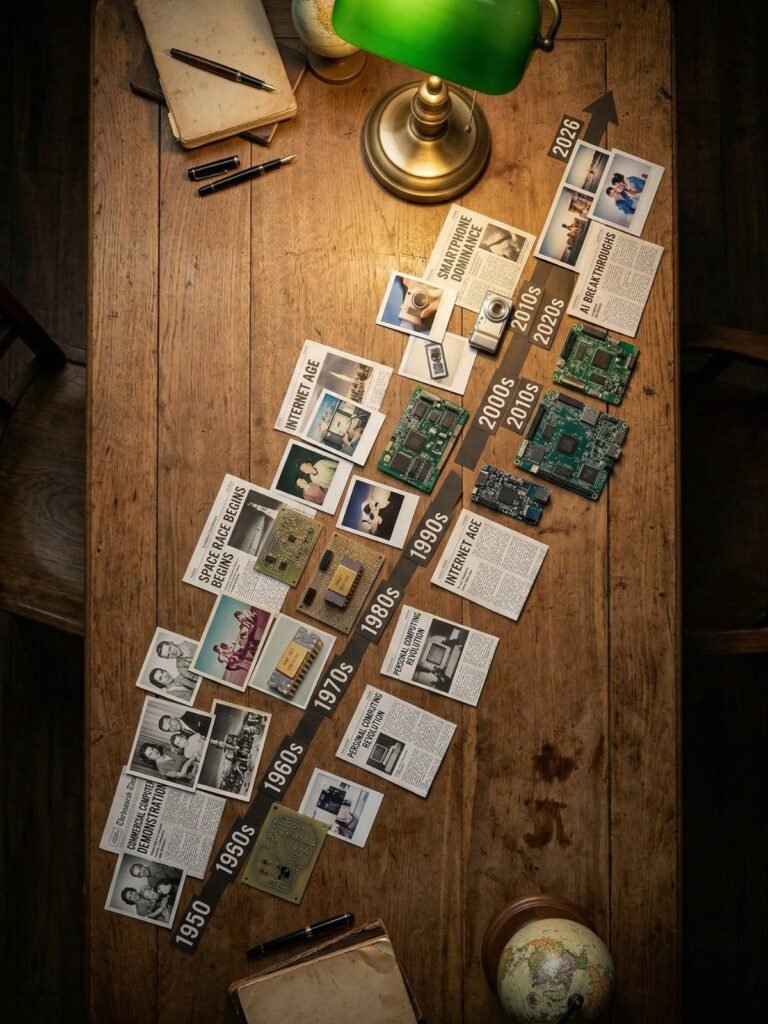
The AI timeline — milestones year by year
From Turing in 1950 to agents in 2026. The moments that changed everything, explained by why they matter today.
Types of AI — the classification that matters
What each "type of AI" actually means, and why what you use today isn't what you see in the movies.
What is a language model — LLMs explained for your aunt
An LLM is autocomplete on steroids. It learns text patterns. That's why it can write, summarize, translate and code — and why it sometimes makes things up.

Generative AI — what it is and why it reshaped knowledge work
From machines that classify to machines that write, design, and code. How the 2017 Transformer architecture ended up as a free text box in November 2022.

The future of AI — what's coming in the next 24 months
Agents that act, AI inside every app, models that know you. The practical question isn't when AGI arrives — it's what you do with the next two years.

Anthropic and Claude — the company that took the long road
Born from a disagreement inside OpenAI in 2021. Five years on it's the AI company that the most serious professionals choose to trust — and not by accident.

OpenAI and ChatGPT — the one that turned the lights on
ChatGPT didn't invent artificial intelligence. It invented something rarer: a moment when a hundred million people — your mom, your boss, your lawyer friend — discovered it at the same time. Everything that came after starts there.

Google and Gemini — the giant that had to wake up
It showed up six months late to the party it had helped set up. Three years later, it owns the widest distribution on the planet and a technical model that no longer asks anyone for permission. Gemini's story is the story of a giant forced to move.
xAI and Grok — the AI that lives inside Twitter
Elon Musk founded xAI in July 2023 after falling out with the company he'd co-founded himself. Two and a half years on, Grok is the only frontier AI that sees the public conversation in real time — and the most polarizing bet on the market.
Microsoft and Copilot — distribution as AI strategy
Microsoft didn't build the best model. It built something harder to dislodge: the model that sits where people already work. Office, Windows, GitHub, Teams. The play has a huge strength and an Achilles' heel worth looking at head-on.

Meta and Llama — the quietest AI rollout in the world
More than five hundred million people use Meta AI each month inside WhatsApp, Instagram, and Facebook — most of them unaware there's a model called Llama running behind it. At the same time, Llama is the reason an actual open-source AI community exists today.
China's AI labs — DeepSeek, Qwen, and the other side of the race
DeepSeek hit #1 on the US App Store on a Monday in January 2025. That same day Nvidia lost $589 billion in market cap. The technical angle is interesting; the political one is more so.

The AI race — Claude vs ChatGPT vs Gemini vs the rest
In 2026 the interesting question stopped being which AI wins. It became which one you use for what. This is the honest map — with each tool's real strengths and the stack I actually run.
Open vs closed models — the battle that shapes the future
What 'open' actually means, what 'closed' actually means, and why for a mature professional the right question isn't which one wins — it's which one to pair with which.

Practical guide
What a prompt is — the most important instruction you will ever write
The first thing you ever typed into ChatGPT was already a prompt. Understanding why some work and others don't is the line between using AI as a toy and using it as a work tool.

The CAFÉ Method — the complete framework that transforms every prompt
Four letters, one shared language. The framework I use every day in my consulting work so AI stops answering for the average user and starts answering for you.

Prompt library — ready to copy, paste, and use
The best prompt is the one you already wrote. A living library beats a thousand best-prompts-of-the-year roundups — and every prompt we share is built with CAFÉ visible inside, with the four letters labeled, so you learn while you copy.

Claude deep dive — what it can do (and what most people miss)
Claude isn't just a chat box. Artifacts, Projects, MCP, Cowork, Claude Code, scheduled tasks, skills — a tour of the whole house, room by room, including the rooms most users never walk into.

ChatGPT deep dive — images, GPTs, voice, and the full ecosystem
ChatGPT is the most used AI on the planet, and there are concrete reasons for that. Images with DALL-E 3, real-time voice conversation, custom GPTs, Canvas, web search, Operator, and Sora. An honest guide — without hiding what's good — to what OpenAI built.

Gemini deep dive — the AI that lives inside every Google product
Gemini doesn't compete to be the best conversational AI. It competes to be where you already are: Gmail, Docs, Sheets, Drive, Maps, Android, Chrome. Its superpower is distribution.

Copilot deep dive — the AI already inside your Office, whether you noticed or not
Microsoft isn't racing for the coolest chatbot. It's racing to be inside every app your company already pays for. That's a different game.

Grok deep dive — the X-native AI that actually reads the feed
Claude, ChatGPT, and Gemini answer from a world that ends yesterday. Grok answers from what's happening on X right now. That edge is real — and so is the price tag on it.
Chinese AI deep dive — DeepSeek, Qwen, and what you can use today
On January 27, 2025, a small Chinese lab wiped $600 billion off global market cap in a single day. If you still think 'China copies,' you missed the chapter.