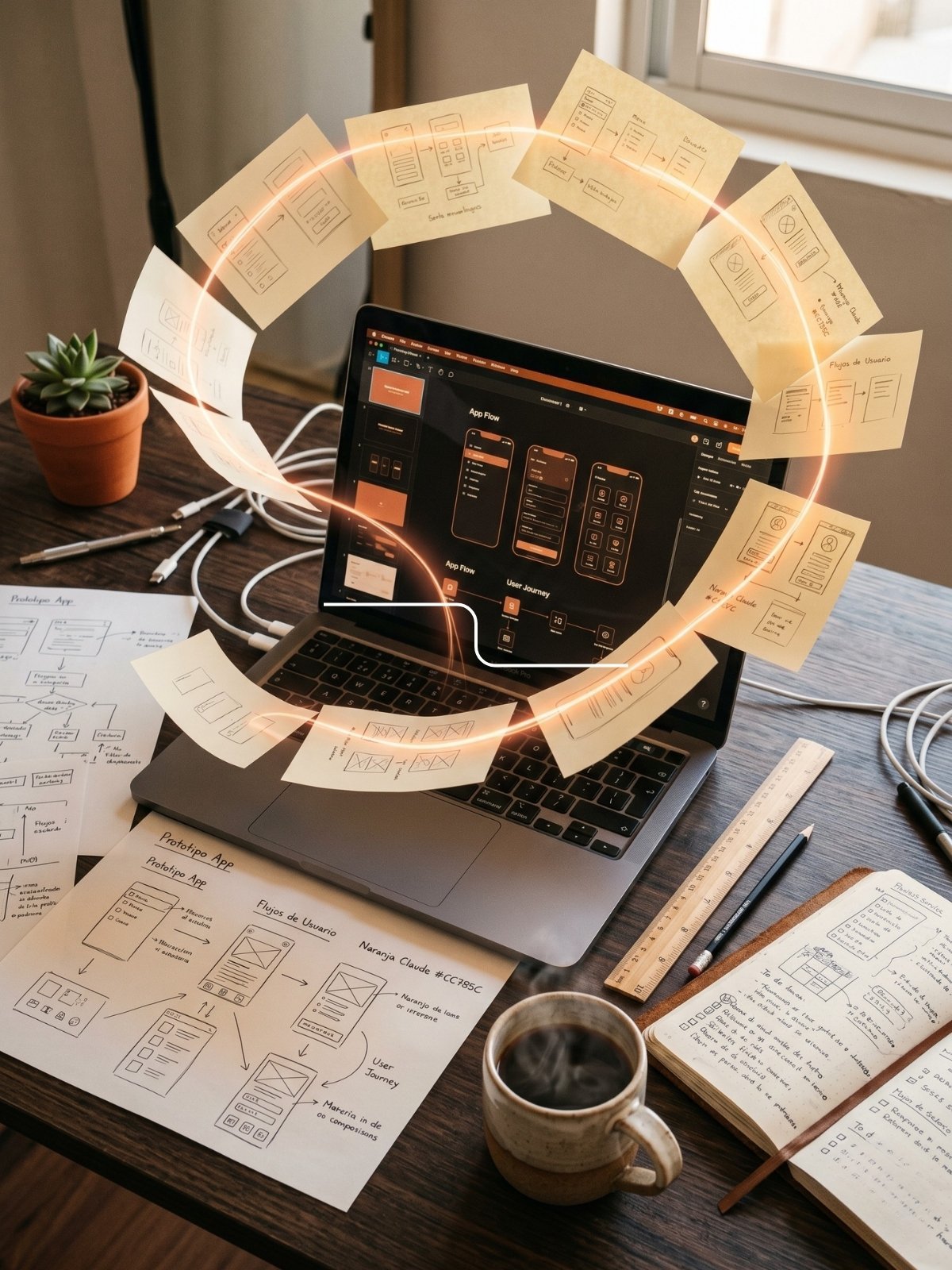
You've been there. A presentation due tomorrow, PowerPoint open, cursor blinking on a blank slide.
It's not that you don't know what to say. It's that going from "I know what I want to communicate" to "something that looks like a real presentation" takes forever — and that gap eats hours you don't have.
Describe what you need. Claude builds it. That's the whole promise of Claude Design.
This week, Anthropic launched Claude Design, a new feature inside Claude. It's not a separate app or a plugin. If you already have a paid Claude plan, it's available in your account right now.
What you can make with it
You describe what you need — a five-slide presentation with last quarter's results, a one-page summary to send to a client, a rough sketch of what an app screen could look like — and Claude builds it.
Not a template you fill in. Not a form. A conversation: you explain what you need, Claude interprets it, and produces something visual that you can then refine with more instructions or edit directly.
When you're done, you export. The file comes out as a PDF, a shareable URL, a PPTX you can open in PowerPoint, or straight into Canva if that's where you normally work.
Who this is actually for
Anthropic is direct about this: Claude Design is built for people who aren't starting from a design tool and need to get from an idea to something visual quickly.
That means founders who need to show an idea before they have budget. Managers who need a deck for a board meeting. Consultants who need a one-pager for a client. People who have something to say but don't want to spend two hours making it look presentable.
If you already live in Figma and work on product design professionally, this probably won't replace your workflow. But for everything else — the presentations, the one-pagers, the "can someone make this look decent" requests — it fills a real gap.
Try it today
Claude Design is in research preview, which means some things won't work perfectly yet. But it's functional. If you have a Pro, Max, Team, or Enterprise plan, go to claude.ai and look for Design in the sidebar.
A good first prompt: describe a project you've been putting off because it didn't feel worth making visual. Two or three sentences — what it is, who the audience is, what you want them to walk away understanding. See what comes back in under a minute.
Is there a document sitting in your drafts right now that just needs to become a slide deck?
On Thursday, Anthropic shipped Opus 4.7. On Friday, it shipped Claude Design. On Friday, Figma's stock dropped.
That sequence wasn't random.
"You describe it. Claude designs it. Figma shareholders noticed the same day."
Claude Design is a new feature inside Claude — available now in research preview for Pro, Max, Team, and Enterprise subscribers — that converts a text description into visual output: presentation decks, interface prototypes, one-pagers, sales materials. It's not a design editor. It doesn't replace Figma or a product designer. But it does replace something that many professionals either do poorly or keep postponing: turning an idea into something visual without having to learn another tool.
What it does and what it doesn't
The workflow has three steps you already know from any Claude conversation: describe, get a draft, refine.
The difference is that the output isn't text. It's a presentation, a prototype, a page. And you can export it as PDF, URL, PPTX, or send it directly to Canva.
What it handles well: slide decks from a written briefing, project or product one-pagers, basic interface prototypes for communicating ideas, and materials that respect your company's design system if you share your codebase or style files.
What it doesn't do, and doesn't try to: brand identity or visual design from scratch, image generation or illustration, or high-fidelity wireframes for complex product development.
That distinction matters. Claude Design isn't for designers. It's for everyone else — for people who need "something visual and presentable" and currently either lose an hour in PowerPoint or ask someone else to handle it.
A real example: the deck you've been postponing
Here's a scenario that should feel familiar. You need to present a project update to leadership next week. Not complex, but it needs to look like something. You know what you want to say, but you don't have time to build slides from scratch.
Without Claude Design: you open PowerPoint, pick a template, start moving boxes around, lose 90 minutes, the result is "good enough."
With Claude Design: you type something like this in the chat —
"I need a five-slide deck to present Q1 results to our executive team. The project is X, the key numbers are these, and the main message is that we're on track but need more budget for Q2. Corporate feel, not boring."
Claude produces the first version. You review it, tell it what to change, export to PPTX. Real time, including revisions: 15 to 20 minutes.
Will the output be perfect on the first try? Not always. But you'll have something to edit instead of a blank screen. And that gap — between "blank screen" and "draft to improve" — is where most of the time actually goes.
Why Figma felt this
Figma has more than four million active users, according to the company's own figures. When Claude Design launched, its stock moved. Not because Claude Design is better than Figma — it isn't, at least not today — but because the market read the signal: the barrier to functional design is dropping.
The same pattern played out when Word introduced templates. When Excel made dashboards automatic. Design tools aren't going away. But "communication design" — presentations, internal materials, one-pagers — is probably heading toward not needing a dedicated tool.
For you, the practical read is simpler: there's a layer of work you used to delegate or postpone. That layer now has a tool.
The bigger context: Anthropic's week
This week Anthropic shipped two things in two days. First Opus 4.7, with better vision and stronger performance on long tasks. Then Claude Design, which runs on top of Opus 4.7.
The logic holds: Anthropic's most capable model now has a dedicated interface for design work. It's not that Anthropic became a design company — it extended what Claude can do inside a professional workflow.
This tracks the direction they've been moving since late 2025: less general-purpose chat, more specific tools for concrete use cases. Projects, MCP, scheduled tasks, and now Claude Design. Each one is a new layer on top of the same model.
How many tasks in your week that you currently do in a different tool could actually be done in Claude, and done better?
When Claude Design launched last Friday, Figma lost market cap within hours. The quick read — "Claude is replacing Figma" — is wrong. But the market's reaction tracked something more precise: a layer of demand that belonged to Figma now has a viable alternative. Figma's investors understood the implication before most observers did.
Mapping exactly where that layer sits is what's worth working out.
What Claude Design is, technically
Claude Design is a new interface layer inside Claude, running on Opus 4.7, available in research preview for Pro, Max, Team, and Enterprise plans. It's not a standalone module — it's a specialization of the conversational interface to produce structured visual outputs.
Available outputs: presentation decks, one-pagers, interface prototypes, corporate communication materials. Export formats: PDF, shareable URL, PPTX, and direct export to Canva.
The UI is split: chat on the left, canvas on the right. Users describe in the chat; Claude generates on the canvas. Refinement happens through conversation, inline comments on specific elements, direct text editing, and custom sliders that Claude itself generates to let users adjust spacing, color, and layout in real time.
The handoff mechanism is strategically notable: when a design is ready to build, Claude Design packages everything into a bundle that can be passed to Claude Code with a single instruction — closing the exploration → prototype → production code loop entirely inside Anthropic's ecosystem.
What's not available today: direct vector editing, full design token support, export to Sketch or editable SVG, and Figma integration (though the Canva export signals that more integrations are planned).
The two Figma segments and where the threat actually lands
Figma has two major user segments, and the exposure isn't symmetric.
Segment 1: Professional UX and product design. Teams building product interfaces, managing design systems, working in handoff with developers. For this segment, Claude Design is not a real threat today. Figma's technical depth, developer integrations, real-time collaboration, and component-level control are not replicated here. A serious product design workflow doesn't simplify.
Segment 2: Corporate communication design. Managers, consultants, founders, analysts, sales and marketing teams who use Figma, PowerPoint, or Canva to produce functional visual materials — decks, one-pagers, reports. Not art. Not software products. Output whose purpose is communication, not construction. For this segment, Claude Design is a direct threat because the work doesn't require Figma's advanced capabilities. It requires speed and brand consistency.
The market correctly read that segment 2 demand has a new alternative. What it overcorrected on was treating both segments as equally exposed.
The design system integration as strategic moat
The ability to integrate an organization's design system is Claude Design's most strategically significant feature at the medium term — and the reason this is an enterprise play, not just a prosumer product.
Today, if you want any general AI assistant to produce "something with your branding," you have to specify it every single time. Manual, fragile, doesn't scale across teams.
With Claude Design integrated into a design system, that context is persistent. The organization configures it once; every output from every team member respects the guidelines automatically. Anthropic describes this precisely: "Every project after that uses your colors, typography, and components automatically."
The implication: this isn't just replacing PowerPoint or Canva for individual use. At scale, it replaces the process where the design team reviews everything before it goes to the client. Visual quality control becomes embedded in the tool itself.
That is a structural risk for Figma — not through its UX users, but because a meaningful share of its enterprise growth comes from being the single place where "things look right and on-brand." Claude Design is building a competing moat at the content layer, not the component layer.
Where Claude Design breaks (the honest counterexamples)
Counterexample 1: Highly visual or illustrative content. If your material requires generated images, custom illustration, photography, or iconography, Claude Design doesn't resolve it today. Output is limited to typographic and structural composition.
Counterexample 2: Legally regulated or compliance-bound documents. If a one-pager or presentation goes through legal review or has rigid format requirements, Claude Design's output will likely require manual rework. Granular layout control isn't there yet.
Counterexample 3: Teams with Figma as their collaboration hub. If your team has established Figma workflows — versioning, inline comments, developer handoffs — adding Claude Design as a parallel tool creates friction without eliminating it. The value is as an exploration and rapid prototyping tool, not a production tool.
Counterexample 4: Research preview caveats. Anthropic's track record with these previews is rapid iteration, but you start with calibrated expectations. There will be edge cases where a 30-minute PowerPoint would produce a cleaner result. The gap closes fast, but it's real in week one.
Anthropic's surface model strategy
There's a recognizable pattern in Anthropic releases since late 2025: every new product extends Claude's surface without changing the underlying model. Projects, MCP, scheduled tasks, Claude in Chrome, Claude Cowork, and now Claude Design are all modes of reaching more workflows with the same core model.
This contrasts with OpenAI's strategy — a general-purpose app plus a powerful API for developers. And with Google's approach of embedding Gemini inside its existing ecosystem where distribution is already solved.
Anthropic is building something structurally different: a layer of specialized tools over a model that already has measurable advantages in reasoning and instruction-following. If the strategy holds, the moat isn't just the model — it's the native tool ecosystem where Claude already understands the context before the conversation starts.
The risk is product coherence. More specialized tools means more complexity for users deciding what to use when. For now, each tool's target segment is distinct enough to avoid real overlap. But as the surface area expands, Anthropic will need a clearer organizing layer between the model and the tools.
What's next
Based on what's visible in the research preview and what the Canva export signals: more export integrations (Figma isn't ruled out as a future destination), better design token and complex design system support, and likely real-time collaboration inside Claude Design for teams.
The unannounced but structurally expected next step: direct visual editing inside the interface, rather than refinement-only by instruction. Today, if you want to move a specific element on a slide, you describe it to Claude. The natural progression is a basic integrated visual editor — similar to what Canva does with its AI layer on top of its own canvas.
If in 12 months Claude Design has a basic visual editor, Figma export, and full design token support — what portion of corporate communication design still requires a dedicated tool?
My read: very little. And that's exactly what Figma's investors priced in on Friday.