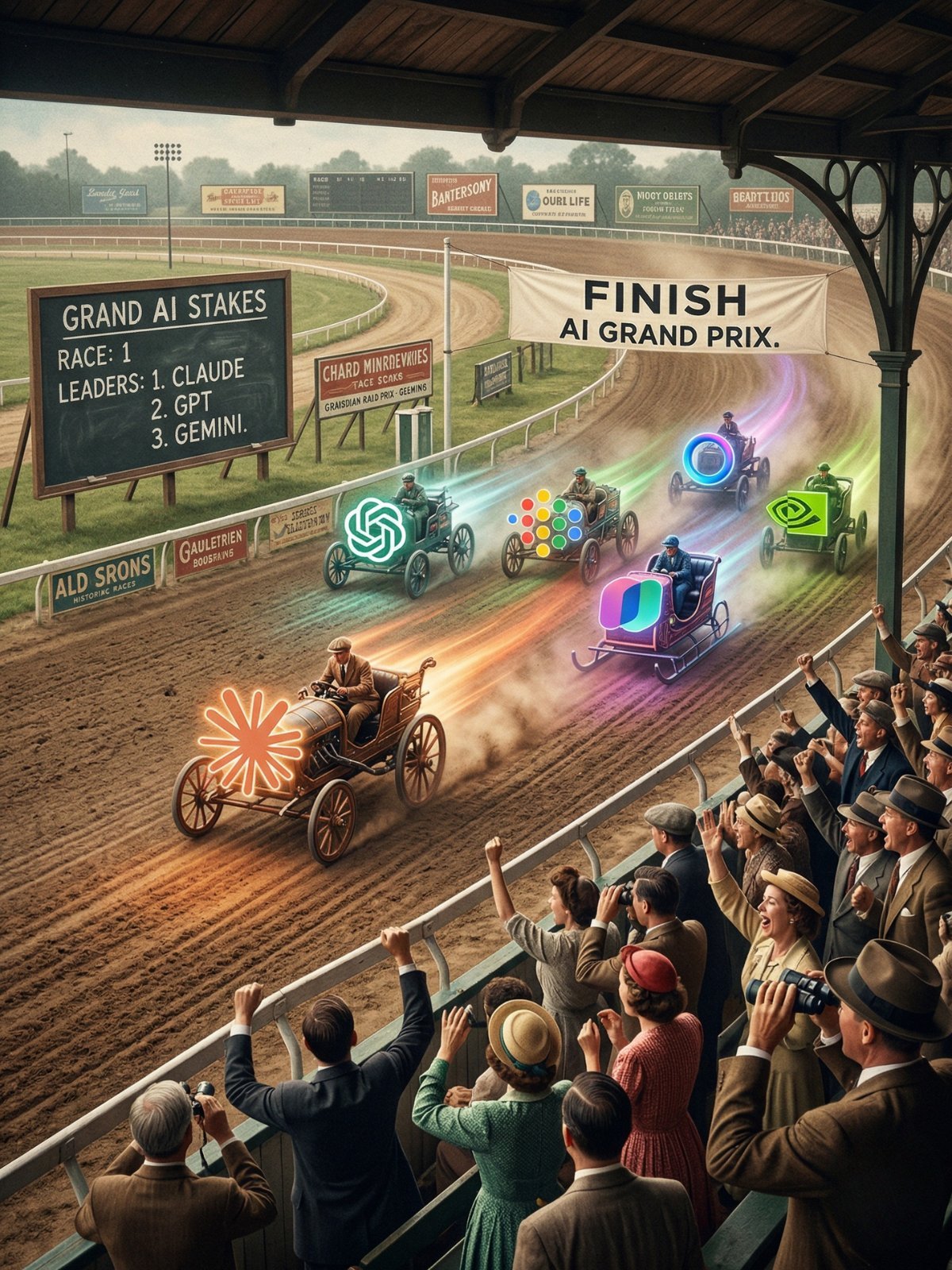
In 2024 the market question was still competitive: "who's going to win the AI race?" Global rankings, fights for benchmark top spots, talk of imminent monopoly. Two years later the question mutated. In 2026 no serious person asks who wins — they ask what each one wins at.
The conversation stopped being competitive and turned architectural.
Why it fragmented
There's a technical reason and a market reason.
The technical one is that frontier models converged. Claude Opus 4.7, GPT-5o, Gemini 2.0 Ultra, and Llama 4 all sit in the same performance band on general benchmarks like MMLU — within three percentage points. When raw capability difference is marginal, the differentiator shifts: speed, context, integration, tone, honesty, built-in tools, price. And each vendor picked a different axis.
The market reason is that every provider figured out fighting on every front doesn't pay. Better to own a professional niche clearly than to place second or third everywhere. That produced a visible specialization over the last year — each AI is increasingly recognizable by the "shape" its owner gave it.
The big four, one by one
Claude, from Anthropic. The one I use as professional default. The real strengths, without decoration: superior writing quality in Spanish and English for professional work; literal following of complex instructions; long code that holds coherence across hundreds of lines; honesty when it doesn't know (it says "I don't have that" instead of inventing); Constitutional AI makes refusals predictable and explainable. Where it's not the first pick: no image generation, no competitive voice mode, limited integration with office suites.
ChatGPT, from OpenAI. The most versatile as a consumer experience. Where it clearly wins: image via DALL-E 3 directly in the chat; advanced Voice mode with low latency; massive ecosystem of custom GPTs others already configured; deep integration with Microsoft Office via Copilot; the largest community and public example base in the industry. Where it gives ground: hallucinations remain materially more frequent than Claude on factual tasks; turbulent internal governance after the Altman episode and the Sutskever-Leike exit; less predictable for high-stakes professional work.
Gemini, from Google. Best integrated into the Google ecosystem. Where it clearly wins: native integration with Gmail, Docs, Sheets, Drive, and Calendar — it reads your email, edits your document live, searches your files; real-time web search with no hack; context window extended to one million tokens in Gemini 2.0, which lets you load whole books; competitive price, with many features in the free tier. Where it trails: text quality for professional writing sits a step below Claude and ChatGPT; the API changes frequently, which complicates stable integrations.
Grok, from xAI. The most niche but clear owner of its niche. Where it wins: native real-time access to X (Twitter), which enables live trend monitoring and public conversation tracking; fewer content filters than the others, which makes it popular with users who find the rest's restrictions overwrought; visible integration with the X platform. Where it loses: reasoning and writing quality below the other three; less predictable behavior; the association with Elon Musk is a brand issue that splits opinion hard.
The open ones — Llama, DeepSeek, Qwen
The second tier deserves separate mention because it competes on different logic.
Llama, from Meta. Open model with public weights. The 405B version competes in benchmarks with closed frontier models. Its reason for existing is architectural: you can download the weights, deploy on your own infrastructure, and data never leaves. For companies in regulated sectors — health, banking, government — it's the only technically viable option. The cost: it requires an infrastructure team with real ML ops competence.
DeepSeek, from China. DeepSeek V3 is open, and its commercial API pricing is 25 to 35 times cheaper than US competitors. Its R1 reasoning model is competitive in math and code. The tradeoffs: data on the commercial API goes to Chinese servers; certain politically sensitive topics are filtered; Spanish-language performance is far below Western models. For high-volume English text analysis on a tight budget, it's unbeatable.
Qwen, from Alibaba. Similar to DeepSeek in philosophy — open, Chinese-origin, strong on benchmarks. Less international penetration but growing fast, especially in the open source community that builds fine-tunes on top of these models.
The use-case matrix
To ground it in real decisions, a simple matrix:
| Case |
First pick |
Why |
| Draft a client proposal |
Claude |
Text quality and honesty about what it doesn't know |
| Analyze an 80-page contract |
Claude |
Long context plus precision on legal detail |
| Generate images for a post |
ChatGPT |
DALL-E still leads on general text-to-image |
| Hold a voice conversation |
ChatGPT |
Voice mode has the best latency and naturalness |
| Work inside Gmail + Docs |
Gemini |
Native integration saves window switching |
| Load a whole book and ask about it |
Gemini 2.0 |
One million tokens of context |
| Monitor live trends on X |
Grok |
Only one with real native real-time access |
| Host AI on your own server |
Llama |
Only open option with consistently competitive quality |
| High-volume English text, tight budget |
DeepSeek |
25 to 35 times cheaper per token |
| Code going to production |
Claude or GPT |
Both competitive, Claude more predictable on long edits |
The table doesn't exhaust cases. It sets the reflex. What matters is internalizing that no single first pick is the same across all cases.
Why leader rotation is evidence, not noise
The Chatbot Arena leaderboard at lmarena.ai — the public model ranking voted by users in blind comparisons — shows an interesting data point: over the last year no model held first place for more than six to eight weeks. Rotation is constant. Claude goes up, Gemini pulls ahead, GPT ships a new version and recovers, an open model shows up.
That isn't instability. It's evidence of real fragmentation. If the race were about a single podium, we'd see a sustained leader. What we see instead is a field where several models are "good enough" and the ordering depends on what gets measured that week. That's the defining feature of the 2026 market.
My default and why
I'm writing this piece from a declared position: my main tool is Claude. Worth explaining why — with arguments, not fandom.
In applied consulting, the most expensive risk isn't paying a premium plan. It's delivering an invented answer to a client that sounds convincing. The properties that prevent that mistake are honesty, literal instruction following, and consistency in refusals — and Claude sits measurably ahead on those three in human evaluations.
But that's my main task. If my work were producing daily visual content, I'd use ChatGPT as default and Claude as secondary. If I worked full-time inside Google Workspace, I'd start with Gemini. The choice isn't about which model is best in the abstract; it's about which combination maps better to your workflow.
What's your main task, and which tool solves it best? If you want to dig into how models get objectively compared, How AIs are measured takes the benchmarks apart and explains how to read them without falling for marketing. If you want to understand the specific bet open models make, Open vs closed models is the next link.
Picture the scene: a friend corners you at a barbecue. They've got a drink in one hand and they've been told at work they "need to start using AI." They ask which one they should pick. You have thirty seconds before the conversation drifts back to sports.
This is the mental map worth keeping ready.
There's no single winner — there are four good ones at different things
The "which AI is best" question is set up wrong. In 2026 none of them wins at everything. Each one performs better in a different terrain, and the serious work is knowing which one you use for what.
Think of them as tools. A hammer isn't better than a screwdriver — they're for different things. AI works the same way today.
The big four, one line each
Claude (from Anthropic). Best for professional work where your reputation's on the line. Careful writing, long-document analysis, code that's going to ship, complex instructions followed to the letter. Its rarest virtue: when it doesn't know, it tells you. It doesn't make things up.
ChatGPT (from OpenAI). Best if you want to generate images or talk by voice. DALL-E produces strong illustrations inside the same chat. Voice mode lets you have a low-latency conversation, like a phone call. And it has a huge library of "custom GPTs" other people already built for specific tasks.
Gemini (from Google). Best if you live inside Gmail, Docs, and Sheets. It sits glued to your email, calendar, and Drive files. What other AIs have to guess, Gemini reads straight from your Google account. For teams already on Workspace, the difference shows up the first day.
Grok (from xAI, Elon Musk's company). Best if you need to know what's being said on X right now. It has direct platform access and fewer filters than the others. For live trend monitoring, there's no competitor.
The open ones — Llama, DeepSeek, Qwen
There's a second group that doesn't have a free chat box for the general public, but it matters. Llama (from Meta), DeepSeek (Chinese), and Qwen (also Chinese) are "open" models: you can download them, host them yourself, and run the AI inside your own infrastructure. Nobody outside sees the data.
Useful in two cases. One, if you work with very sensitive data (client contracts, medical records, trade secrets) and you can't send it to a third-party cloud. Two, if your volume is so large that paying per question gets expensive and running your own server comes out cheaper.
For everyday use they're not the first pick. For specific professional cases, they're the only one.
How I translate that into a practical decision
If you ask me which one to use, my answer is a simple matrix:
- Your reputation's on the line with what you deliver: Claude.
- You need to generate an image or talk by voice: ChatGPT.
- Your day runs on Gmail + Docs + Sheets: Gemini.
- You want to know what's being said on X right now: Grok.
- Your data can't leave the company: an open model with your own hosting.
Most professionals don't need all five. They need one as default, and maybe a second for when the first one falls short.
What to take away
Three things for when your friend at the barbecue asks again:
- There's no winner — there's a map. The right question isn't "which AI" but "which AI for what task." If someone sells you an AI as the best for everything, be skeptical.
- Start with the task you do most. If you write proposals all day, start with Claude. If you generate posts with images, start with ChatGPT. The AI that gives you a good first result with little effort is the one worth getting to know deeply first.
- Trying costs almost nothing. All of them have free tiers or one-to-seven-day trials. Before paying a subscription, run the same real task in two or three of them and compare. Within ten minutes you'll know which one is yours.
In 2024 the market question was still competitive: "who's going to win the AI race?" Global rankings, fights for benchmark top spots, talk of imminent monopoly. Two years later the question mutated. In 2026 no serious person asks who wins — they ask what each one wins at.
The conversation stopped being competitive and turned architectural.
Why it fragmented
There's a technical reason and a market reason.
The technical one is that frontier models converged. Claude Opus 4.7, GPT-5o, Gemini 2.0 Ultra, and Llama 4 all sit in the same performance band on general benchmarks like MMLU — within three percentage points. When raw capability difference is marginal, the differentiator shifts: speed, context, integration, tone, honesty, built-in tools, price. And each vendor picked a different axis.
The market reason is that every provider figured out fighting on every front doesn't pay. Better to own a professional niche clearly than to place second or third everywhere. That produced a visible specialization over the last year — each AI is increasingly recognizable by the "shape" its owner gave it.
The big four, one by one
Claude, from Anthropic. The one I use as professional default. The real strengths, without decoration: superior writing quality in Spanish and English for professional work; literal following of complex instructions; long code that holds coherence across hundreds of lines; honesty when it doesn't know (it says "I don't have that" instead of inventing); Constitutional AI makes refusals predictable and explainable. Where it's not the first pick: no image generation, no competitive voice mode, limited integration with office suites.
ChatGPT, from OpenAI. The most versatile as a consumer experience. Where it clearly wins: image via DALL-E 3 directly in the chat; advanced Voice mode with low latency; massive ecosystem of custom GPTs others already configured; deep integration with Microsoft Office via Copilot; the largest community and public example base in the industry. Where it gives ground: hallucinations remain materially more frequent than Claude on factual tasks; turbulent internal governance after the Altman episode and the Sutskever-Leike exit; less predictable for high-stakes professional work.
Gemini, from Google. Best integrated into the Google ecosystem. Where it clearly wins: native integration with Gmail, Docs, Sheets, Drive, and Calendar — it reads your email, edits your document live, searches your files; real-time web search with no hack; context window extended to one million tokens in Gemini 2.0, which lets you load whole books; competitive price, with many features in the free tier. Where it trails: text quality for professional writing sits a step below Claude and ChatGPT; the API changes frequently, which complicates stable integrations.
Grok, from xAI. The most niche but clear owner of its niche. Where it wins: native real-time access to X (Twitter), which enables live trend monitoring and public conversation tracking; fewer content filters than the others, which makes it popular with users who find the rest's restrictions overwrought; visible integration with the X platform. Where it loses: reasoning and writing quality below the other three; less predictable behavior; the association with Elon Musk is a brand issue that splits opinion hard.
The open ones — Llama, DeepSeek, Qwen
The second tier deserves separate mention because it competes on different logic.
Llama, from Meta. Open model with public weights. The 405B version competes in benchmarks with closed frontier models. Its reason for existing is architectural: you can download the weights, deploy on your own infrastructure, and data never leaves. For companies in regulated sectors — health, banking, government — it's the only technically viable option. The cost: it requires an infrastructure team with real ML ops competence.
DeepSeek, from China. DeepSeek V3 is open, and its commercial API pricing is 25 to 35 times cheaper than US competitors. Its R1 reasoning model is competitive in math and code. The tradeoffs: data on the commercial API goes to Chinese servers; certain politically sensitive topics are filtered; Spanish-language performance is far below Western models. For high-volume English text analysis on a tight budget, it's unbeatable.
Qwen, from Alibaba. Similar to DeepSeek in philosophy — open, Chinese-origin, strong on benchmarks. Less international penetration but growing fast, especially in the open source community that builds fine-tunes on top of these models.
The use-case matrix
To ground it in real decisions, a simple matrix:
| Case |
First pick |
Why |
| Draft a client proposal |
Claude |
Text quality and honesty about what it doesn't know |
| Analyze an 80-page contract |
Claude |
Long context plus precision on legal detail |
| Generate images for a post |
ChatGPT |
DALL-E still leads on general text-to-image |
| Hold a voice conversation |
ChatGPT |
Voice mode has the best latency and naturalness |
| Work inside Gmail + Docs |
Gemini |
Native integration saves window switching |
| Load a whole book and ask about it |
Gemini 2.0 |
One million tokens of context |
| Monitor live trends on X |
Grok |
Only one with real native real-time access |
| Host AI on your own server |
Llama |
Only open option with consistently competitive quality |
| High-volume English text, tight budget |
DeepSeek |
25 to 35 times cheaper per token |
| Code going to production |
Claude or GPT |
Both competitive, Claude more predictable on long edits |
The table doesn't exhaust cases. It sets the reflex. What matters is internalizing that no single first pick is the same across all cases.
Why leader rotation is evidence, not noise
The Chatbot Arena leaderboard at lmarena.ai — the public model ranking voted by users in blind comparisons — shows an interesting data point: over the last year no model held first place for more than six to eight weeks. Rotation is constant. Claude goes up, Gemini pulls ahead, GPT ships a new version and recovers, an open model shows up.
That isn't instability. It's evidence of real fragmentation. If the race were about a single podium, we'd see a sustained leader. What we see instead is a field where several models are "good enough" and the ordering depends on what gets measured that week. That's the defining feature of the 2026 market.
My default and why
I'm writing this piece from a declared position: my main tool is Claude. Worth explaining why — with arguments, not fandom.
In applied consulting, the most expensive risk isn't paying a premium plan. It's delivering an invented answer to a client that sounds convincing. The properties that prevent that mistake are honesty, literal instruction following, and consistency in refusals — and Claude sits measurably ahead on those three in human evaluations.
But that's my main task. If my work were producing daily visual content, I'd use ChatGPT as default and Claude as secondary. If I worked full-time inside Google Workspace, I'd start with Gemini. The choice isn't about which model is best in the abstract; it's about which combination maps better to your workflow.
What's your main task, and which tool solves it best? If you want to dig into how models get objectively compared, How AIs are measured takes the benchmarks apart and explains how to read them without falling for marketing. If you want to understand the specific bet open models make, Open vs closed models is the next link.
The public Chatbot Arena table at lmarena.ai — the global model ranking voted in blind comparisons by real users — records a pattern that in 2024 would have looked impossible: over the last calendar year no model held first place for more than six to eight consecutive weeks. Claude Opus 4.7 reached the top in April, GPT-5o displaced it last November, Gemini 2.0 Ultra had its window in February, and frontier open source models (Llama 4 Maverick, DeepSeek V3-R2) appeared intermittently in the top 5.
That rotation isn't statistical noise. It's structural evidence that the AI race stopped being a competition for "the best model" and became a competition for specialization. Worth disassembling what that means technically and strategically.
Fragmentation as steady state
The dominant hypothesis in 2022-2023 was convergence to a winner. The logic: returns to scale (compute + data + capital) were going to produce a winner-take-all effect where the leader would consolidate an insurmountable advantage. That hypothesis didn't hold, and there are three discrete technical reasons.
Frontier capability convergence. Closed and open frontier models sit within three percentage points on MMLU, within four on GSM8K, and within five on HumanEval. When raw benchmark differences are marginal, the differentiator shifts to axes benchmarks don't capture — tone, integration, latency, cost, honesty, predictability. Each vendor optimized a different axis.
Diminishing returns to pure scale. The Chinchilla scaling results (Hoffmann et al., 2022) and subsequent work suggest that past a certain size, marginal returns per added parameter drop sharply. The industry responded by moving innovation to non-scalar techniques: RLAIF at Anthropic, reasoning-time compute in OpenAI's o1/o3, extended context at Gemini, efficient Mixture-of-Experts at DeepSeek. That expanded the surface where you can win.
Specialization as rational strategy. Given the enormous fixed cost of training a frontier model (estimated at 100 to 500 million USD per cycle), no vendor can afford to lose on every front. The rational economic answer is to pick a defensible axis and dominate it. Anthropic chose professional reliability. OpenAI chose consumer ecosystem and distribution. Google chose vertical integration with its products. xAI chose real-time plus X. The open players chose cost and control.
The steady state of the market in 2026 is specialized fragmentation, not consolidation. That state is likely to persist until one of the underlying technical constraints changes fundamentally (a new architecture beyond transformers, a jump in compute cost structure, etc.).
Vendor-by-vendor analysis, with editorial honesty
Worth stating each frontier vendor's position with technical precision and without fandom.
Anthropic / Claude. Core strength: reliability on delegable work. Constitutional AI produces explainable and consistent refusals; Opus 4.7's instruction literalism makes the model especially useful for agents and multi-turn pipelines; honesty about uncertainty (admits "I don't know") reduces false positives on factual tasks. Honest limitations: no image generation, a late and weak voice mode, an integration ecosystem much smaller than OpenAI's. Sustainable competitive advantage: internal culture (technical founders, focus on alignment as architectural property) produces a model that requires less external verification, which is economically valuable for professional users with real stakes.
OpenAI / ChatGPT. Core strength: distribution. ChatGPT has a hundred million active users and is the first AI any non-technical person tries. The custom GPT ecosystem turned the platform into an aggregator where third parties add value without friction. DALL-E 3 and advanced Voice mode remain best-in-class in their categories. Microsoft 365 integration via Copilot guarantees massive corporate presence. Limitations: hallucination persists at 5-8% on factual QA (vs 2-3% for Claude on internal evaluations); institutional stability post-Altman/Sutskever remains an open question; o1/o3 models are powerful but expensive per request, which limits widespread use. Sustainable edge: network effects — the more users and developers in the ecosystem, the more valuable the ecosystem, and that's hard to dislodge.
Google / Gemini. Core strength: vertical integration with its own products. Gemini 2.0 inside Workspace has privileged access to user data (mail, docs, drive, calendar) no competitor can replicate without explicit user opt-in; the one-million-token context window (Gemini 2.0 Pro) is the longest on the market and enables use cases — whole-repo analysis, entire books — the others don't serve well. Limitations: text quality for long professional writing sits below Claude and ChatGPT; the historical API has a reputation for instability; internal tension between AI teams (recently merged DeepMind + Google Brain) produces occasional product inconsistency. Sustainable edge: Google owns the distribution via Android and Workspace and can ship Gemini as default on billions of devices without asking permission.
xAI / Grok. Core strength: clear niche in real-time plus fewer filters. Native X access gives Grok a type of input (live public conversation) the rest structurally lacks. The more permissive filter policy captures an audience that finds competitors overreaching. Severe limitations: reasoning and writing quality measurably below; less predictable behavior on edge cases; dependence on Musk's personal brand introduces reputational volatility. It's the most niche of the big four and will likely stay that way.
Open models (Llama, DeepSeek, Qwen). Core strength: control and cost. The bet is that for clients with hard privacy requirements or aggressive budgets, open is non-negotiable. Llama 405B competes on benchmarks with closed models at a fraction of marginal cost (assuming the client absorbs infrastructure cost). DeepSeek V3 offers commercial API at 25-35x lower prices than OpenAI/Anthropic. Limitations: conversational experience quality sits a step below; the requirement for a technical team limits adoption to companies with ML ops competence; Chinese models (DeepSeek, Qwen) carry Western regulatory risk.
The layer hierarchy
I propose a three-layer taxonomy to order the market. It's the same one I use in consulting to decide client architecture.
Layer 1 — Raw capability. Frontier models competing on academic benchmarks (MMLU, GSM8K, HumanEval, ARC). Here there's a technical tie between Claude, GPT, Gemini, Llama, and DeepSeek. No vendor sustains dominance. The layer is relevant for research and for cases where five percent more accuracy moves outcomes materially. For most professional use, this layer is no longer the differentiator.
Layer 2 — Integration and distribution. Who reaches the end user with the least friction. ChatGPT via Microsoft Copilot and its own app; Gemini via Workspace and Android; Grok via X; Claude via Anthropic direct plus partners like Databricks and Vertex AI. Here OpenAI and Google have structural advantages hard to displace. Anthropic chooses not to compete directly on this layer — it specializes in being the best option for whoever already showed up looking for professional quality.
Layer 3 — Professional reliability. Models a professional can delegate work to with accountability and spot-check, not line-by-line. Here Claude has a measurable edge. The difference isn't visible in benchmarks — it shows up in rewrite rates, in frequency of detected hallucinations in production, and in reliability on following complex instructions. It's the segment with the highest willingness to pay for quality and the lowest price sensitivity.
A mature client doesn't pick on layer 1 (everyone ties). They pick considering layer 2 (which integrations they already have) and layer 3 (what level of risk they tolerate). That calculation explains why the optimal 2026 architecture is almost always multi-model.
My personal stack, exposed
I'll close with the stack I actually run in production for applied consulting. Not prescriptive — illustrative.
Professional default: Claude Opus 4.7. Everything that involves delegating work with accountability — proposals, contract analysis, code for clients, report writing, blog content curation, long-document work. About 70% of my daily usage.
Multimedia consumer: ChatGPT Plus. Image generation for blog and materials, voice mode for rehearsing spoken responses, experimentation with third-party custom GPTs. About 15% of usage, but saturated during visual content sprints.
Google-context: Gemini 2.0 Pro via Workspace. Work inside client documents living in their Drives, analysis over specific Gmail threads, extended-context cases where a single inference needs to load more than 500K tokens. About 10% of usage, critical on certain projects.
Self-hosted open source: Llama 3.3 70B on my own server. Clients in regulated sectors (legal, health, financial) where data can't cross to third-party clouds. About 5% of usage, but represents a larger share of revenue because the projects are longer and more specialized.
Notice something about the stack: no model sits at zero. Each covers a niche where it clearly outperforms, and deciding what to use when is part of the professional work. The most important mental shift I made over the last two years was moving from "find the best AI" to "build the best combination."
Editorial thesis
The AI race stopped being a podium and turned into a map.
Winning in 2026 isn't having the best model or being a fan of one brand. Winning is picking the right tool for the right task — and knowing when to switch tools without feeling it as betrayal. The mature consultant's work, the serious professional's work, the work of anyone using AI to produce, is no longer "which AI is still winning" but "which combination do I use and when do I change it."
That thesis has practical consequences. It means compulsive benchmarking doesn't scale — you pick axes relevant to your workflow and ignore the rest. It means loyalty to one AI brand is expensive — it makes you cede value in niches where that brand isn't best. It means real AI literacy is no longer "knowing how to use ChatGPT"; it's knowing how to map tasks to tools and keep that architecture alive as the market moves.
That's the thesis that holds the rest of this blog together. If you want to dig into the critical reading of benchmarks and why you should stop taking them literally, How AIs are measured takes apart the epistemology of the field. If you want to understand the specific bet open models make and when it makes sense to pick them over closed ones, Open vs closed models analyzes the trade-off in detail.
What's your personal AI stack today — the combination you run and the criteria you use to switch between tools?