How an AI "thinks" — no jargon, for humans
An ordinary morning on your phone
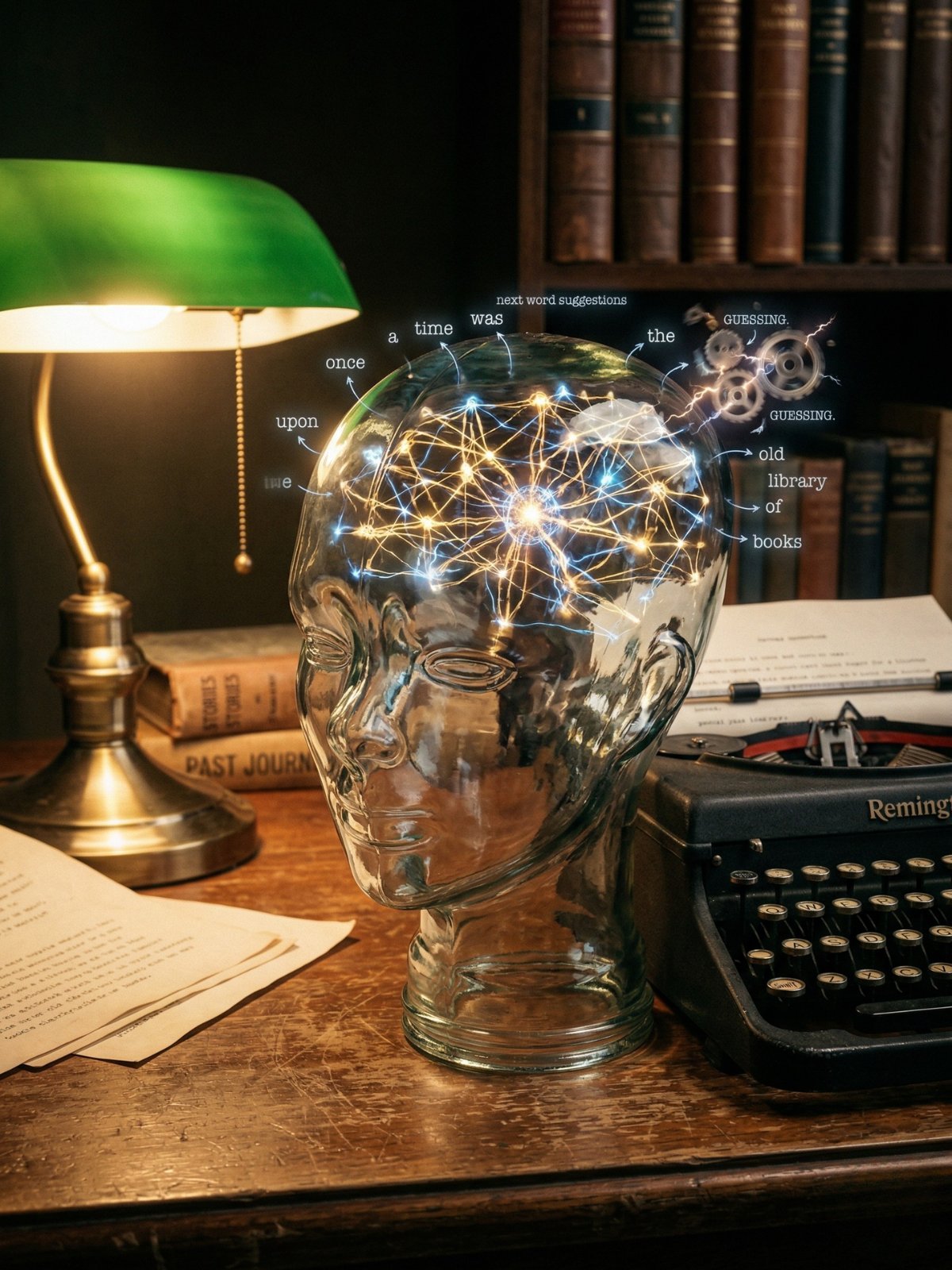
You open WhatsApp. You type: "Hey, how are…". The keyboard suggests "you." It didn't think. It predicted.
A generative AI does exactly the same thing, but at a scale that's hard to picture. It's called a Large Language Model, and it's a word-prediction machine trained on so much text that its predictions end up sounding intelligent.
But they aren't. They're probabilities. That's the trick, and that's the limit.
How it was trained
Creators feed the model brutal amounts of text. GPT-3 was trained on roughly 300 billion tokens, according to the original paper (Brown et al., 2020, NeurIPS). Later models used even more. We don't have exact public numbers for the latest Claude or GPT-4, but they're in the same order of magnitude or higher.
The model reads all that and learns correlations. It doesn't "understand" concepts. It learns: after "the cat" you probably get "is," "jumps," or "meows" — almost never "studies math."
That learning freezes into neural weights — numbers inside the connections between simulated artificial neurons. GPT-3 has 175 billion of those weights. That's the official figure, from the same paper. The biggest 2024 models have more, though companies publish fewer details every year.
How it predicts in real time
You type: "Analyze this balance sheet and…". The model does this:
First. It converts every word into numbers. Those numbers are called embeddings and live in a mathematical space with thousands of dimensions.
Second. It runs those numbers through layers of multiplications and additions. Many layers.
Third. At the end it calculates a score for every possible word in its vocabulary (around 50,000 words or sub-word fragments for GPT-2, as a verifiable reference point).
Fourth. The word with the highest score wins. That's the next one.
Fifth. That word gets fed back into the system. And it predicts the next. And another.
That's how a whole paragraph gets generated, one word at a time, while you watch it appear on screen.
What changes for you
It means the AI doesn't genuinely understand meaning. It doesn't know what a balance sheet is. It doesn't know if your numbers are right. What it does is: "after 'analyze this balance sheet,' you probably get 'revenue,' 'expenses,' 'your margin improved'…" Statistically plausible words.
That's why it works well for three kinds of tasks. Writing an email. Summarizing a text. Explaining a known concept. The pattern is in those 300 billion words of training.
That's also why it fails in three other kinds. New truths it didn't see in training. Facts specific to your business. Things that happened last week. There it guesses.
Here's the most important detail. When it guesses wrong, it does it with the same confidence as when it guesses right. That's called a hallucination. The machine has no internal thermometer for certainty.
The architecture that changed everything
Until 2017, AIs processed text slowly and sequentially. Word by word. Then Google published a paper called "Attention Is All You Need" (Vaswani et al., 2017) and everything broke.
The paper introduced transformers. The key innovation is the attention mechanism. Instead of reading word by word, the model processes the whole paragraph in parallel. And it decides, mathematically, how much each earlier word matters for predicting the next one.
That paper now has more than 100,000 citations. It changed everything. Without transformers there's no ChatGPT, no Claude, no Gemini.
Without context, it predicts generically
If you say "write me an email," the AI predicts the most average email possible. Its predictions come out generic because it has no clues from you.
With context — your business, your voice, your specific problem — the predictions adjust. That's the entire point of the CAFÉ method: clear Context, concrete Action, precise Format, defined Style. It's not a trick. It's giving the model more signal so its predictions come out yours.
What most people miss
A lot of people assume the AI has "knowledge inside" or some "magical understanding of the world." It has none of that. It has numbers. When you ask a question, those numbers rearrange in ways that proved to work well on similar cases during training.
It's like a chef who read 50,000 recipes but never tasted the food. They know where the salt goes because it's in all the texts. They don't know how the food tastes because they never tried it.
That metaphor matters. The AI can talk brilliantly about topics it never experienced. It can write poetry about pain without ever having felt anything. It can explain how to ride a bike without balance of its own.
It's text that produced patterns. Not lived experience that produced text.
Next time you use one
An open question for you: if the AI predicts statistically, how different would the result be if you gave it three examples of how you write? What about ten? What about telling it who you're writing to?
That's the difference between using a generic AI and making it predict like you. If you want to understand why Claude distinguishes better between what it knows and what it doesn't while other models hallucinate more, we cover that in another article in the series.
For now, remember: the AI predicts. Give it clear clues, a concrete task, specific form, your own sound. That's how its predictions end up working for you.
How an AI "thinks" — no jargon, for humans
A scene you've already lived
You're typing a message on your phone. You tap "Good" and the keyboard offers "morning." You tap "How" and "are" pops up. You don't even notice. It's autocomplete.
Now imagine that exact trick, trained on hundreds of billions of words. Books. Articles. Code. Conversations. Essentially the whole internet.
That's a generative AI. A gigantic autocomplete.
The idea in two minutes
When you write something to Claude or ChatGPT, the machine doesn't "understand" what you said. What it does is predict the next most likely word. Then predict the one after that. And the next. One at a time.
It works astonishingly well because it read brutal amounts of text. GPT-3, the model that kicked off the ChatGPT boom, was trained on roughly 300 billion words (Brown et al., 2020). That's more text than you could read in a thousand lifetimes.
The learning lives in what we call weights — numbers inside the neural network. When you write a prompt, the machine multiplies those numbers in very sophisticated ways, and a probable word falls out.
So why does it sometimes lie?
Because it confuses probability with truth. To the machine, they're the same thing.
If its training data had a thousand false articles on a topic, it learned those false patterns. It'll predict them with the same full confidence it uses for true things. There's no internal organ separating "this is real" from "this sounds real."
That's why sometimes it tells you things with expert-level authority and they're wrong. It's not lying out of malice. It's predicting. And what it predicts isn't always true.
Why this matters to you
Because it changes how you should use it.
If you think the AI understands, you'll ask it things the way you'd ask a human. Vague. No context. You'll be disappointed.
If you understand it's predicting, you'll give it clear clues. You'll tell it who you are, what you want, how it should sound, what format you expect. The AI grabs those clues and its predictions adjust. They come out yours, not generic.
That's the whole secret. No magic. Just probability.
Three ideas to take with you
First: the AI doesn't think, it predicts. It works because it read mountains of text and learned which words follow which. That's all.
Second: that's why sometimes it lies with total confidence. It doesn't distinguish truth from falsehood. It distinguishes statistically probable from improbable.
Third: if you want good results, feed it plenty of context. Your business, your voice, your specific problem. The more it knows about you, the better it predicts for you.
How an AI "thinks" — no jargon, for humans
An ordinary morning on your phone
You open WhatsApp. You type: "Hey, how are…". The keyboard suggests "you." It didn't think. It predicted.
A generative AI does exactly the same thing, but at a scale that's hard to picture. It's called a Large Language Model, and it's a word-prediction machine trained on so much text that its predictions end up sounding intelligent.
But they aren't. They're probabilities. That's the trick, and that's the limit.
How it was trained
Creators feed the model brutal amounts of text. GPT-3 was trained on roughly 300 billion tokens, according to the original paper (Brown et al., 2020, NeurIPS). Later models used even more. We don't have exact public numbers for the latest Claude or GPT-4, but they're in the same order of magnitude or higher.
The model reads all that and learns correlations. It doesn't "understand" concepts. It learns: after "the cat" you probably get "is," "jumps," or "meows" — almost never "studies math."
That learning freezes into neural weights — numbers inside the connections between simulated artificial neurons. GPT-3 has 175 billion of those weights. That's the official figure, from the same paper. The biggest 2024 models have more, though companies publish fewer details every year.
How it predicts in real time
You type: "Analyze this balance sheet and…". The model does this:
First. It converts every word into numbers. Those numbers are called embeddings and live in a mathematical space with thousands of dimensions.
Second. It runs those numbers through layers of multiplications and additions. Many layers.
Third. At the end it calculates a score for every possible word in its vocabulary (around 50,000 words or sub-word fragments for GPT-2, as a verifiable reference point).
Fourth. The word with the highest score wins. That's the next one.
Fifth. That word gets fed back into the system. And it predicts the next. And another.
That's how a whole paragraph gets generated, one word at a time, while you watch it appear on screen.
What changes for you
It means the AI doesn't genuinely understand meaning. It doesn't know what a balance sheet is. It doesn't know if your numbers are right. What it does is: "after 'analyze this balance sheet,' you probably get 'revenue,' 'expenses,' 'your margin improved'…" Statistically plausible words.
That's why it works well for three kinds of tasks. Writing an email. Summarizing a text. Explaining a known concept. The pattern is in those 300 billion words of training.
That's also why it fails in three other kinds. New truths it didn't see in training. Facts specific to your business. Things that happened last week. There it guesses.
Here's the most important detail. When it guesses wrong, it does it with the same confidence as when it guesses right. That's called a hallucination. The machine has no internal thermometer for certainty.
The architecture that changed everything
Until 2017, AIs processed text slowly and sequentially. Word by word. Then Google published a paper called "Attention Is All You Need" (Vaswani et al., 2017) and everything broke.
The paper introduced transformers. The key innovation is the attention mechanism. Instead of reading word by word, the model processes the whole paragraph in parallel. And it decides, mathematically, how much each earlier word matters for predicting the next one.
That paper now has more than 100,000 citations. It changed everything. Without transformers there's no ChatGPT, no Claude, no Gemini.
Without context, it predicts generically
If you say "write me an email," the AI predicts the most average email possible. Its predictions come out generic because it has no clues from you.
With context — your business, your voice, your specific problem — the predictions adjust. That's the entire point of the CAFÉ method: clear Context, concrete Action, precise Format, defined Style. It's not a trick. It's giving the model more signal so its predictions come out yours.
What most people miss
A lot of people assume the AI has "knowledge inside" or some "magical understanding of the world." It has none of that. It has numbers. When you ask a question, those numbers rearrange in ways that proved to work well on similar cases during training.
It's like a chef who read 50,000 recipes but never tasted the food. They know where the salt goes because it's in all the texts. They don't know how the food tastes because they never tried it.
That metaphor matters. The AI can talk brilliantly about topics it never experienced. It can write poetry about pain without ever having felt anything. It can explain how to ride a bike without balance of its own.
It's text that produced patterns. Not lived experience that produced text.
Next time you use one
An open question for you: if the AI predicts statistically, how different would the result be if you gave it three examples of how you write? What about ten? What about telling it who you're writing to?
That's the difference between using a generic AI and making it predict like you. If you want to understand why Claude distinguishes better between what it knows and what it doesn't while other models hallucinate more, we cover that in another article in the series.
For now, remember: the AI predicts. Give it clear clues, a concrete task, specific form, your own sound. That's how its predictions end up working for you.
How an AI "thinks" — no jargon, for humans
Why understanding the mechanics makes you a better user
If you use AI without knowing how it works under the hood, you get lucky when it works and frustrated when it doesn't. Understanding the mechanics lets you build better prompts, diagnose failures, and know when to trust or doubt the output.
This isn't an academic lecture. It's pragmatic reverse engineering for anyone planning to base real decisions on language models.
AI doesn't think. It runs mathematical transformations on high-dimensional vectors to estimate probability distributions over a vocabulary. Translated: it predicts what word comes next based on patterns learned during training.
The transformer architecture
The key paper is Vaswani et al., "Attention Is All You Need" (NeurIPS 2017). Eight pages that changed everything. The central innovation: the attention mechanism.
Before that, language models processed text sequentially, with architectures called RNN or LSTM. Slow. Hard to scale. Transformers broke the ceiling.
You type: "The cat walked into the house and fell asleep in the chair because it was...". The model doesn't process word by word. It processes the whole paragraph simultaneously, and attention decides, mathematically, how much each earlier word weighs for predicting the next.
That lives in attention weights. Numbers between 0 and 1. In this example: "cat" might weigh 0.4, "asleep" 0.3, "chair" 0.2, the rest split the remaining 0.1. The model then combines those weights and generates a probability distribution over the next word: "comfortable" 0.52, "tired" 0.18, "quiet" 0.09, thousands of other options with smaller probabilities.
The model can take the most likely option (greedy decoding) or sample from the distribution with some temperature for variety. That's the only place something like "creativity" lives: controlled noise over a distribution.
Embeddings: the geometry of meaning
Every token lives as an embedding — a vector in a mathematical space with thousands of dimensions. It's not "the word cat." It's a point in an abstract space.
The useful property: semantically similar words cluster together. "Cat," "feline," "kitty" form a cluster. "Dog" sits in a nearby region. "Shoe" lives far away.
When the model predicts, it computes distances and inner products in that space. It's pure geometry. There's no understanding. There are coordinates.
The famous example from the word2vec paper (Mikolov et al., 2013): "king - man + woman ≈ queen." Solvable with vector arithmetic. That was the moment the industry started to grasp that meaning, at an operational level, could be encoded geometrically.
Tokens, not words
A detail most people miss: the AI doesn't process whole words. It processes tokens. Sub-word fragments.
"Disorganize" usually ends up as three tokens: "Dis," "organ," "ize." GPT-2 uses a BPE (Byte Pair Encoding) vocabulary of 50,257 tokens. Official figure from Radford et al. (2019). Later models expanded that vocabulary, but the order of magnitude holds.
Three operational implications. First: you pay per token in APIs, not per word. Second: context limits are measured in tokens, not words. Third: non-English languages fragment into more tokens, making them effectively more expensive and slower.
Why some models are better than others
It's not because they "think harder" or "understand better." It comes down to three concrete factors.
First, training data. More volume and better curation produce models that generalize better. Anthropic, for example, has publicly stated that it filters data to reduce toxic content and prioritize editorial quality. OpenAI stays more secretive. Google trains on different data. Every corpus leaves a fingerprint.
Second, architecture and scale. More parameters isn't always better, but up to a point it scales representational capacity. Kaplan et al. (2020) and Hoffmann et al. (2022) published "scaling laws" mapping how models improve with more compute, more data, and more parameters. The relationship isn't linear, and there are diminishing returns.
Third, fine-tuning and RLHF. After pretraining, models get tuned with human feedback. Reinforcement Learning from Human Feedback. Anthropic added another layer: Constitutional AI (Bai et al., 2022), where the model critiques its own outputs against a set of principles. That doesn't change how it predicts internally, but it changes what it predicts in sensitive situations and when it refuses.
That's why Claude tends to recognize "I don't know" and say it, while other models confidently predict false answers. It's not moral virtue. It's a choice of tuning data. They penalized confident hallucinations harder during RLHF.
Limited generalization
This is the point most optimistic analysts skip. AI doesn't generalize the way humans do.
A human sees three examples and extracts a principle. An AI needs millions of examples. And what it "extracts" are statistical correlations, not causal principles.
If you teach it "A is like B, B is like C," a human infers "A is like C" without hesitation. A language model may or may not follow that transitive chain if it didn't appear enough in its data. Recent papers show exactly this kind of failure in symbolic reasoning tasks.
Three practical implications. Trained biases. If the data was biased, the model reproduces those biases as distributions. Not out of malice, out of pure statistics. Persistent hallucinations. If something sounds statistically plausible, the model generates it, true or not. Weakness in rare cases. Anything infrequent in training produces fragile patterns; that's why models fail on atypical logical problems.
What this means operationally
Five principles that change how you use language models once you've internalized the above.
First, give it generous context. More context is more signal. Examples, constraints, desired style. A prompt isn't an order. It's a frame the model samples from.
Second, be specific about the task. "Write me an email" is a vague frame that produces average output. "Write a 150-word email asking a supplier for a payment extension, formal but warm" is a narrow frame that collapses the distribution toward useful outputs.
Third, verify in critical domains. Money, customers, irreversible decisions. The model's output can sound correct even when the prediction is false. There's no internal traffic light.
Fourth, use different models for different tasks. Claude tends toward better calibration around uncertainty. GPT-4 has strengths in code (its GitHub-heavy training is public). Gemini pushes multimodal capabilities. There's no "best." There's "best for your case."
Fifth, separate confidence from correctness. The model is equally confident when it lies and when it tells the truth. Confidence is an output of the distribution, not an epistemic guarantee.
The blog's thesis
I've written a lot about this and landed on a conviction I'll defend. The people who get the most out of AI aren't the most technical or the most enthusiastic. They're the ones who internalized the mechanics: this is statistical prediction, not comprehension.
Technical people sometimes get lost in the math and forget the final product is text being generated live in front of a user. Enthusiasts sometimes anthropomorphize and get disappointed when the model fails at something it "obviously" should know.
Good users operate from a third stance. They know the model predicts. They build their prompts to feed it signal. They verify where truth matters. And they're not shocked when it fails, because they know exactly where statistics ends and their human responsibility begins.
AI doesn't understand. But it predicts well enough that you can build real systems on top of it. The trick isn't hoping it will understand. It's knowing when to trust the prediction and when to ask for a second opinion.